
Improve Sampling Safety with Engineered Grab Sampling Systems

Improving Grab Sampling Safety at a Tank Storage Facility
One of Swagelok Louisiana's customers was looking to improve the safety, consistency, and reliability of routine grab sampling at a Gulf Coast chemical facility. By moving from partially open sampling methods to an engineered closed-loop grab sampling approach, the site aimed to reduce operator exposure, improve sample integrity, and standardize sampling practices across routine operations.
The Challenge: Reducing Risk in Grab Sampling

The customer’s operators used sampling practices that included hoses connected to sample cylinders and open bottle sampling through valves. The process created multiple potential exposure points to process fluids, including hazardous hydrocarbons such as butadiene.
Additionally, traditional sampling made it difficult to achieve consistent, representative samples. The setup, flow control, and varying operator techniques introduced inefficiencies and variability, highlighting the need for a safer, more controlled approach.
The Solution: Transitioning to a Closed-Loop Grab Sampling System

Working closely with the customer’s team, Swagelok Louisiana provided application-specific design guidance, on-site technical support, and recommendations focused on creating a safer, more controlled sampling approach. This collaborative effort helped build confidence in both the proposed solution and the long-term partnership.
As a result, the tank storage company transitioned from unsophisticated, partially open sampling methods to a fully engineered, closed-loop approach designed to improve containment, repeatability, and sample accuracy. The solution included two grab sampling system configurations tailored to their application needs:
- GSL-3 is a continuous-flow bottle sampling configuration often used when minimal purge or complexity is required
- GSL-4 is a more advanced configuration that includes additional features like purge, improved isolation, or enhanced safety/cleanliness control
What Is a Closed-Loop Grab Sampling System?
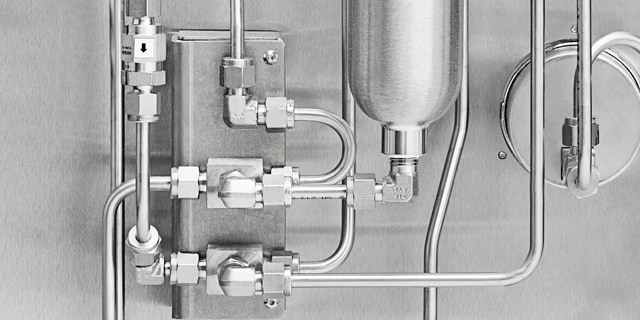
A closed-loop grab sampling system is an engineered method that collects a representative sample from a process stream while keeping the fluid fully contained. Process fluid flows through a sealed circuit, where a portion is captured and the remainder is returned to the system—helping reduce operator exposure and prevent emissions.
Benefits of Closed-Loop Sampling Systems

-
Reduced operator exposure:
Closed-loop sampling helps keep process fluids contained in a sealed system, minimizing opportunities for contact, spills, or emissions. -
Improved sample reliability:
Continuous flow helps reduce stagnant zones so samples better reflect real process conditions. -
Safer disconnect and cleanup:
Integrated purge functionality helps clear residual media before disconnecting, reducing trapped pressure and cross-contamination risk. -
More repeatable operations:
A standardized system design helps reduce variability between operators and sampling points.
The customer was able to create a more controlled, efficient, and safer sampling process while improving overall sample integrity.
Results: Safer, More Consistent Sampling Operations
Installation and commissioning are underway, representing an important step toward improving safety and operational consistency across the site. By transitioning from outdated methods to a more engineered sampling approach, the customer is positioned to reduce operator exposure, helping minimize risk during hydrocarbon handling, improve sample reliability, and create a more repeatable process for routine sampling activities.

Beyond the technical improvements, the project has helped introduce greater structure and standardization into day-to-day operations—supporting more consistent outcomes regardless of operator or sampling point.
What began as a focused effort to address safety risks has evolved into a broader effort to improve how sampling is approached across the site—prioritizing consistency, efficiency, and long-term operational reliability.
Grab Sampling Questions? We’ve got answers.
Reach out to your local authorized Swagelok sales and service center.