
How a Leading Memory Manufacturer Cut Installation Costs and Improved Fab Reliability

Improving Semiconductor Thermal Management Installation for a Leading U.S. Memory Manufacturer
A flexible‑assembly strategy for semiconductor thermal management helps unlock multimillion‑dollar labor savings, strengthen tool reliability, and support next‑generation semiconductor production.
In advanced semiconductor manufacturing, even small inefficiencies can have outsized impacts on yield, uptime, and overall fab performance. For one of the world’s leading memory producers, those small inefficiencies added up quickly, turning traditional installation practices into a strategic bottleneck across their global fabs. Labor-intensive rigid tubing installations slowed tool deployment, introduced variability, and drove up costs at a time when speed, repeatability, and reliability mattered most.
The challenge was amplified by the scale and complexity of the customer’s operations. With labor pressure rising and fab expansion accelerating, the customer needed a new approach: one that not only reduced installation time but also strengthened reliability and supported long-term scalability.
The Challenge: Labor‑Intensive Installation Practices
As device complexity and fab throughput increased, legacy installation methods—especially rigid tubing cooling loops and inert gas lines—drove excessive labor hours and cost variability. While effective, these systems required extensive labor hours, precise routing, multiple welds, and a high level of installer skill. A single pair of chiller lines could take more than a hundred labor hours to fabricate and install. Additionally, inconsistencies in installation methods created variability that affected reliability. Engineering teams sought a solution that not only reduced labor but increased repeatability, cleanliness, and tool uptime. With labor markets tightening and capital projects accelerating, leadership recognized that installation efficiency had become a strategic necessity across every fab.
Rigid tubing systems require extensive labor, precise routing, and multiple welds-introducing delays and inconsistency at scale.
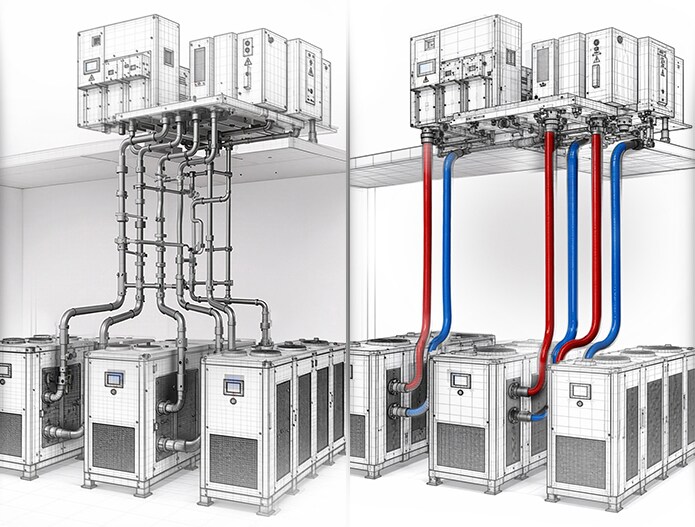
Rigid Tubing
- Complex routing increases installation time
- Multiple welds required across each
- Heavy, rigid runs limit flexibility during install
Flexible Hoses
- Simplified routing
- Fewer connection points
Listening First: Partnering to Understand Root Causes
Having established a strong partnership with the customer, Swagelok had a deep understanding of the customer’s installation workflows, failure modes, and labor constraints. Through extensive onsite engagement—including sub‑fab walk‑downs, installer interviews, and observation of real‑time installation practices—Swagelok engineers documented key bottlenecks.
- Installers struggled with cumbersome routing and rigid tubing runs
- Rigid systems made rework difficult
- Occasional damage to components revealed gaps in best‑practice training
These insights informed a solution that addressed not only the technical requirements of the thermal and inert gas systems but also the human factors that slowed installation and contributed to variability.
The Solution: Flexible Assemblies Tailored for Semiconductor Fabs
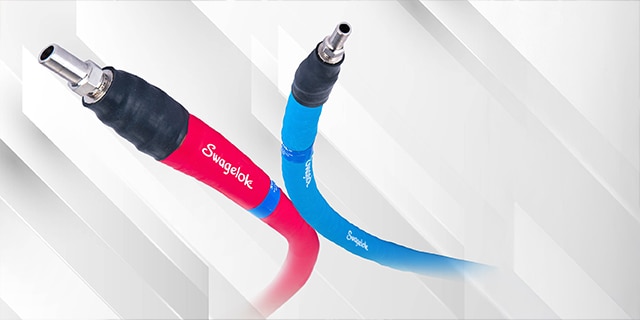
To meet the customer’s aggressive cost-reduction and reliability goals, Swagelok developed a set of engineered flexible assemblies designed to replace rigid tubing. These included insulated chiller hose assemblies for thermal loop applications, flex tubing for inert gas systems, and upgraded diaphragm valves configured with tube butt weld ends. Unlike rigid tubing, flexible assemblies reduced routing complexity, eliminated multiple weld steps, and enabled faster, more repeatable installations. Additional refinements—such as protective spacers, enhanced labeling, and process-driven training materials—were added to address issues identified during field assessments. These assemblies underwent rigorous qualification cycles, including particle generation tests, thermal cycling, pressure extremes, and on-tool validation to ensure performance under the customer’s stringent requirements.
Implementation: Iterative, Tested, and Engineered for Scale
The transition from rigid tubing to flexible assemblies did not occur overnight. The customer’s engineering and chiller development teams worked closely with Swagelok experts over months of testing, reviewing performance data, and refining installation practices. Sub-fab walkthroughs played a critical role, highlighting opportunities to enhance hose protection and installer ergonomics. Swagelok’s Thermal Loop and UHP engineering groups conducted on-site and virtual training sessions covering best practices, hose handling, installation sequencing, and long-term reliability considerations. As confidence grew, the customer scaled the approach from pilot installations to full fab deployments. Each phase yielded additional insights that helped optimize routing, storage, and installation planning, building a robust global standard for future facilities.
Quantifiable Results and Operational Impact
Replacing the traditional rigid tubing approach with flexible assemblies generated dramatic improvements.

Rigid tubing
~126
labor hours per two-line set

Insulated chiller hoses
20-26
hours per

This translated into roughly
$10,000 saved
per pair of chiller hoses

~200 tools
— each requiring at least two hose sets — the customer achieved:

≈ $2 million in labor savings per fab installation cycle
Beyond financial gains, flexible assemblies improved:
-
Reliability by reducing weld‑related leak points
, minimizing installer error, and enabling more consistent routing. -
Tool uptime due to cleaner installation
practices and reduced rework. -
Unified installation strategy
across multiple subsystems.
Why It Matters: Efficiency as a Competitive Advantage
In semiconductor manufacturing, where costs, timelines, and process variability have direct impacts on output and yield, seemingly small improvements can deliver outsized benefits. Flexible assemblies reduce installation labor, streamline tool deployment, and enhance reliability—supporting faster ramp‑ups and more predictable maintenance cycles. As fabs race to add capacity and advance technology nodes, semiconductor thermal management strategies that reduce installation bottlenecks and minimize human‑error risk are becoming essential. The customer’s experience underscores a broader industry shift: optimizing installation practices is now as critical as optimizing the tools themselves.
Beyond Components: A Partnership Built on Trust and Engineering Rigor
The success of this flexible assembly initiative reflects the customer’s leadership in rethinking long-established installation practices and committing to a more efficient, scalable approach across their global fabs. Their engineering, facilities, and procurement teams played a central role in identifying root cause inefficiencies, defining performance and cost requirements, and investing the time and rigor needed to evaluate and validate new solutions through testing and field trials.
Throughout the process, Swagelok collaborated closely with the customer to help translate those requirements into qualified, production-ready solutions. Together, the teams evaluated alternatives, addressed technical challenges, and validated performance using a data-driven approach that balanced operational requirements with engineering expertise. The customer cited technical expertise, responsiveness, and a data‑driven approach as key factors in achieving their cost and performance goals. This collaborative model—driven by the customer’s vision and supported through close engineering engagement—created a strong foundation for global standardization and continuous improvement.
Conceptual rendering and representative data shown for illustrative purposes. Actual system configurations, dimensions, installation requirements, labor hours, and savings may vary by application, facility, and operating conditions.